
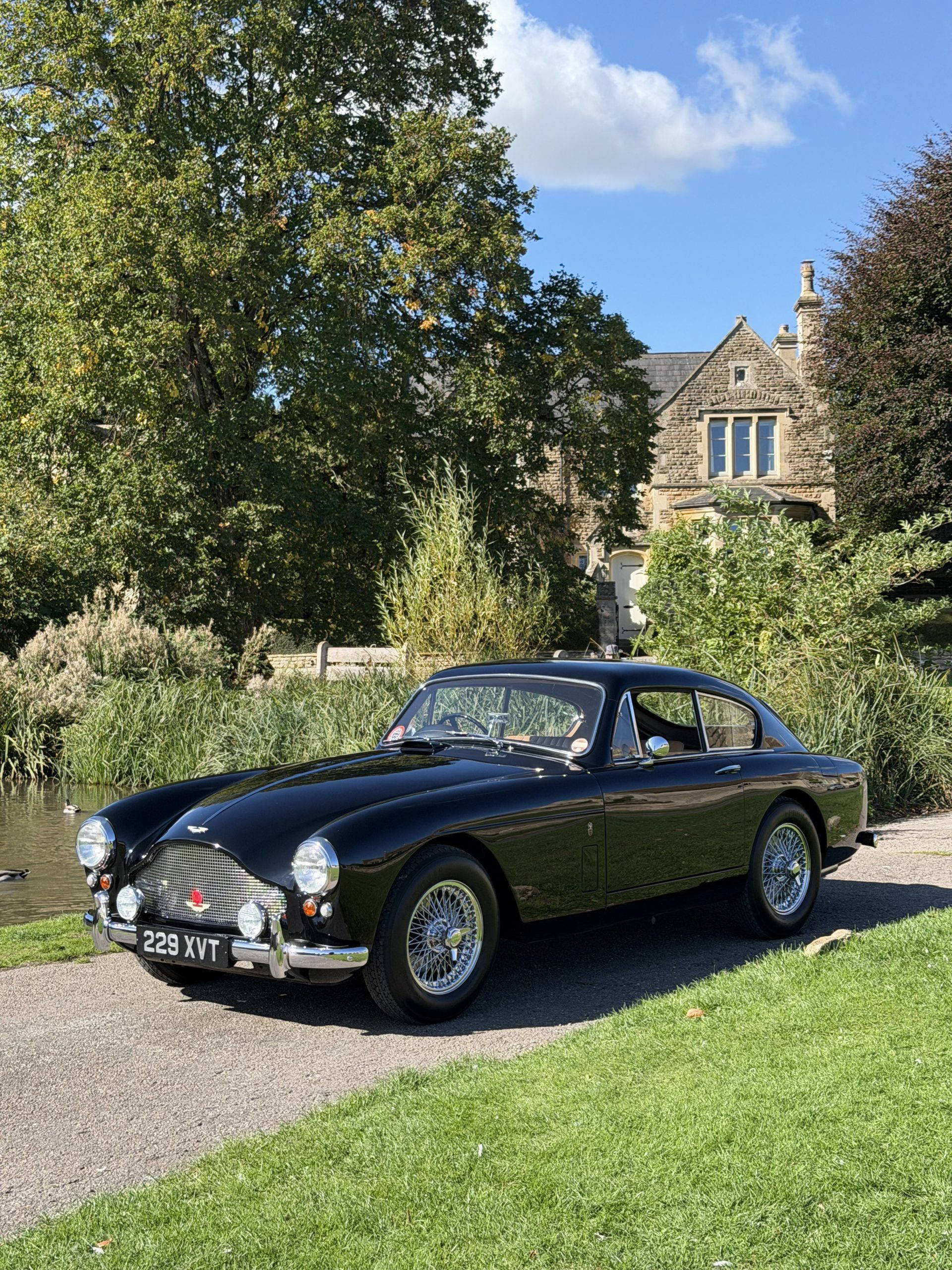
1959 ASTON MARTIN DB 2/4 MKIII
Reg: 229 XVT (originally 2 JPK)
First registered on 06/04/1959
Chassis No. AM300/3/1817
Engine No. DBA/1407
Gearbox No. DBLCW/0/311
Original Dealer Langley Motors – a former dealership in Thames Ditton run by Le Mans 24 Hour winner Roy Salvadori.
The car was fitted with a DBA engine and twin exhausts, which uprated the power from the standard 162 HP to 178 HP.
Its performance was an exhilarating 0 to 60 mph in just 9.3 seconds, topping out at 120 mph, which made it one of the fastest road cars of its era.
The DB Mark III was the first ‘James Bond’ Aston Martin, described as a ‘DB III’ in Ian Fleming’s 1959 novel ‘Gold finger’.
Beautifully presented in its original colour of Masons Black and finished with a beautiful tan Connolly Vaumol hide interior.
The DB Mark III – described as “one of the world’s outstanding sports models” by The Autocar – incorporated lessons learned on the race track with a fundamental redesign of W.O. Bentley’s 3-litre engine by Polish engineer Tadek Marek. It now gave substantially more power and torque than the original LB6. It would be the last of the DB models to be powered by the twin-cam six-cylinder engine of Lagonda origin.
The Mark III was also the final incarnation of the Claude Hill chassis. It was launched simultaneously at the Geneva Motor Show in Switzerland and in the USA in March 1957. An export-only model until it appeared at the London Motor Show that October, it was the company’s first road car to feature the classic Aston Martin grille created by body designer Bert Thickpenny in a sleek new front end that gave a better view of the road ahead. Girling disc brakes were optional at first but became standard after 100 Mark IIIs had been built.
This stunning Mark III is undoubtedly one of the finest examples available. The car was sold new via Roy Salvadori’s Langley Motors, to Thos. S. Penny Limited of Taunton, Somerset in April 1959. It was originally specified with “BLACKMANFRS” (Masons Black) coachwork with Off-White Connolly Vaumol interior and the car is still Masons Black, albeit now with an arguably more elegant with Light Tan Connolly Vaumol hide interior.
From Somerset, the car went to Leicestershire before leaving British shores in 1963 to live in New Zealand where it remained for more than 50 years. When the car was purchased in 2019, it was a true barn-find. Work soon began to return the car to its former glory and was restored to true concours standards. The car has had a bare-metal repaint, an outstanding retrim and extensive mechanical works which means that not only does it look truly breath-taking, it also drives astonishingly well, giving a more exhilarating, sporting experience than the DB4 which replaced it. The sound emitted by the car’s twin exhausts is thoroughly addictive.